

Cement Rotary Kiln: Technical Specifications and Working Principle
Henan Hongke Heavy Machinery Co., Ltd. is a Chinese manufacturer of industrial rotary kilns, rotary dryers, ball mills, crushers and complete cement production lines. The cement rotary kiln is the core equipment for cement clinker calcination. Its specifications and working principle directly affect line output, heat consumption and long-term operation stability. This article reviews cement rotary kilns from three angles: technical specifications, process zones and mechanical structure, as a reference for cement project selection and operation.
1. Technical Specifications: From Diameter and Length to Capacity
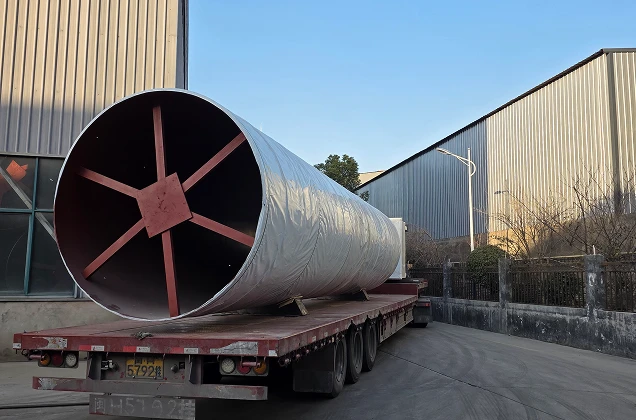
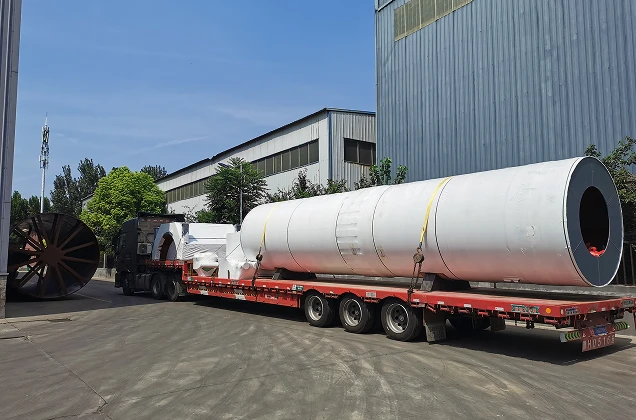
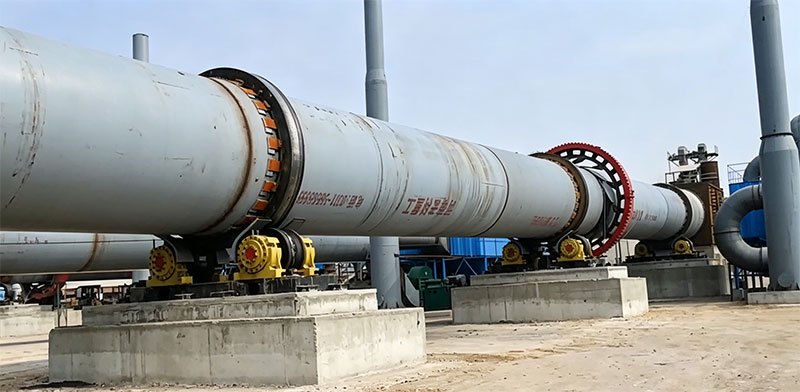
Cement rotary kiln specifications are usually written as “shell diameter × length”, for example Φ3.2×52m, Φ4.3×64m or Φ4.8×74m. Diameter and length decide the internal volume, material retention time and heat exchange area, and therefore affect capacity. The table below lists some typical specifications and main parameters for preliminary selection. Actual selection should be based on raw material properties, fuel conditions and target capacity. Items marked “according to project configuration” should follow the contract technical agreement and final drawings.
Specification (m) | Capacity (t/d) | Inclination (%) | Main drive speed (r/min) | Support stations | Notes |
|---|---|---|---|---|---|
Φ3.2×52 | About 1000 | 3.5 | 0.36–3.57 | 3 | Common for medium-sized lines |
Φ3.5×54 | 1500–1800 | 4 | 0.39–3.9 | 3 | Medium to upper capacity |
Φ4.0×60 | 2500 | 4 | 0.41–4.07 | 3 | One of the main 2500 t/d sizes |
Φ4.3×64 | 3500 | 4 | 0.4–4.0 | 3 | Medium to large lines |
Φ4.8×74 | 5000 | 4 | 0.35–4.0 | 3 | Common 5000 t/d size |
Φ5.0×78 | 6000–8000 | 4 | According to project configuration | 3 | Large production lines |
Data refers to public industry specification tables. Actual parameters should follow the project technical agreement.
The table shows that larger diameter and longer length usually mean higher capacity, but the relationship is not linear. Kiln inclination is usually set between 3.5% and 4%, and main drive speed is mostly in the range of 0.35–4 r/min, so that the material has enough retention time for drying, decomposition and sintering. Three support stations are common; large kilns may use more support points.
2. Working Principle: A Continuous Thermal Process in an Inclined Rotating Shell
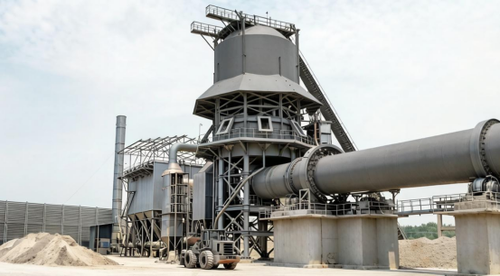
The working principle of a cement rotary kiln can be summarized as follows: raw meal is fed at the upper end (kiln inlet). The shell is installed at an inclination of about 3°–4° and rotates slowly at 1–3 r/min. Under gravity, the material moves toward the lower end (kiln outlet) while exchanging heat with hot gas injected from the kiln outlet in a counter-flow pattern.
Along the kiln length, the process is usually divided into four zones:
Drying zone: free water in the raw meal is evaporated;
Decomposition zone (precalcining / decomposition zone): carbonates decompose, and calcium carbonate converts to calcium oxide with CO₂ release;
Transition zone: liquid phase begins to appear and prepares the material for sintering;
Sintering zone (burning zone): material temperature reaches about 1450°C, clinker minerals form, and flame temperature can reach 1800–2000°C.
The clinker then enters the cooler for rapid cooling. During the whole process, kiln speed, inclination, flame shape and temperature distribution together decide clinker quality and heat consumption. Modern cement kilns usually work with a preheater and precalciner. Raw meal completes part of the decomposition before entering the kiln, which reduces the thermal load on the rotary kiln and allows a more compact kiln size at the same capacity.
3. Mechanical Structure: Support, Drive and Sealing Systems
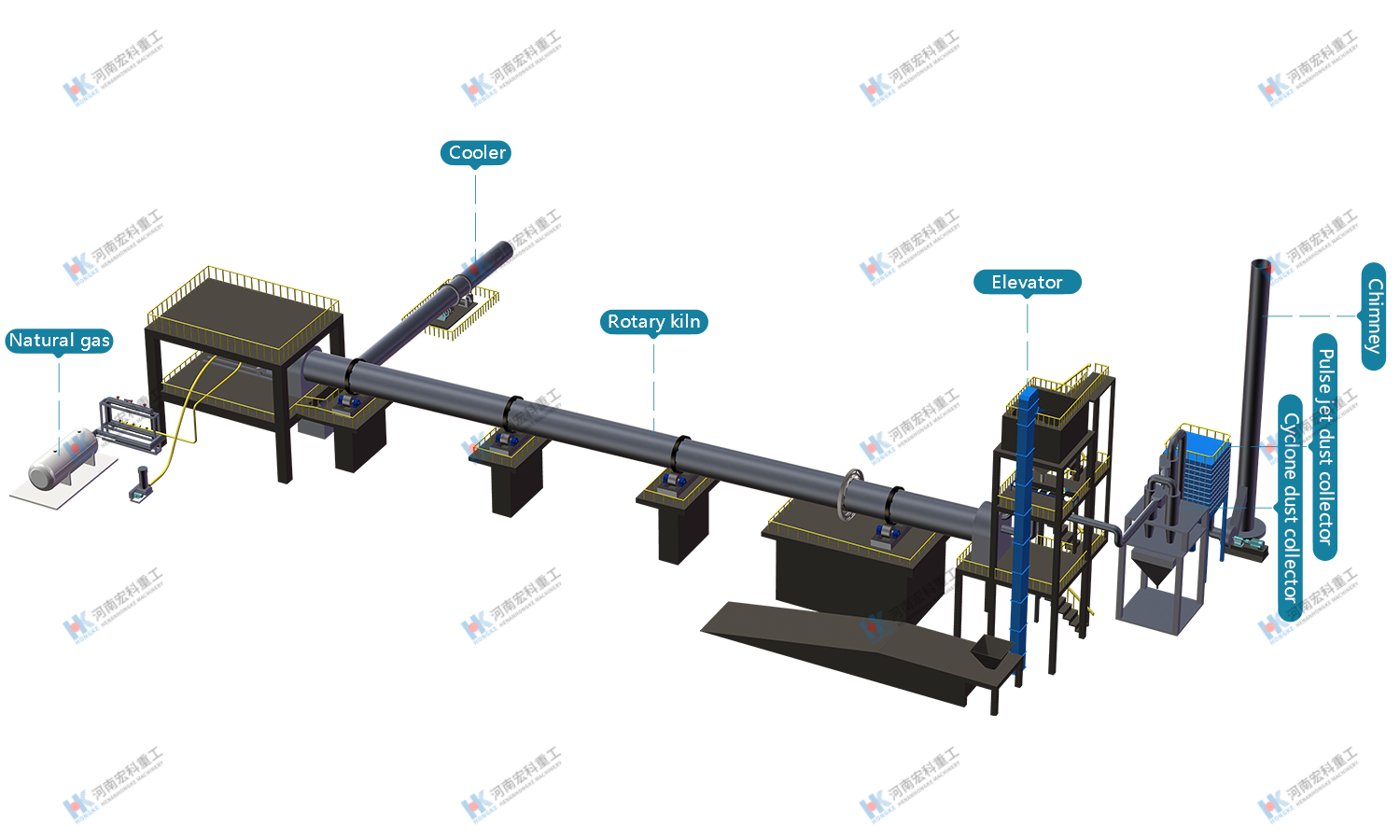
The mechanical structure of a cement rotary kiln is built around one core need: stable rotation at high temperature. Main components include:
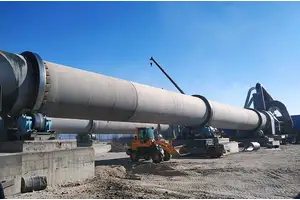
Shell: a cylindrical steel shell rolled and welded from steel plates. It carries mechanical stress from rotation and thermal expansion.
Refractory lining: refractory bricks or castables on the inner side of the shell. They protect the steel shell from temperatures above 1450°C and chemical attack.
Tyres / riding rings: large steel rings fitted around the shell. They transfer the shell load to the rollers.
Rollers / trunnions: heavy-duty rollers that support the tyres, carry the full weight of the kiln and allow rotation with very low friction.
Drive assembly: traditional designs use a girth gear and gearbox. Some modern designs drive the support rollers directly, reducing lubrication points and maintenance work.
Thrust rollers: because the kiln is inclined, the material and kiln weight tend to slide downward. Thrust rollers limit axial movement and keep the kiln in position.
Seals: kiln inlet and outlet seals prevent cold air leakage and hot gas or dust escape. They directly affect thermal efficiency and emission control.
Among these parts, the contact condition between tyre and roller, shell ovality control and refractory integrity are key factors for long-term kiln availability and lining life. Modern large kilns also use infrared scanning, PLC interlocking and online monitoring to track burning zone temperature and drive condition in real time.
4. Energy Efficiency and Industry Trends: Engineering Considerations Beyond Size Selection
Specifications and working principle set the base performance of a cement rotary kiln, but energy consumption and emissions during actual operation are increasingly important in selection and operation optimization. Recent industry technical progress mainly focuses on several directions:
Energy-saving refractory lining: new low-thermal-conductivity refractory bricks reduce heat loss by refining the ceramic microstructure. Industry reports indicate that shell heat loss can be reduced by up to 25%, main burner heat input by 4%–5%, and overall CO₂ emissions by up to 2%.
Electrification and alternative fuels: some technical routes try to replace fossil fuels with combinations of hydrogen, plasma and resistance heating to achieve deeper decarbonization of the rotary kiln.
Data-driven operation optimization: prediction models are used to optimize kiln system stability and free lime (f-CaO) together, reducing coal and power consumption while maintaining clinker quality.
For new or upgraded cement projects, size selection should not only ask “how much capacity for this kiln size”. Fuel adaptability, refractory configuration, sealing form and automation level should also be included in the overall evaluation. A rotary kiln with matched size, reliable structure and proper control is more likely to support stable long-term production than one that simply pursues a larger diameter.
5. FAQ
Q1: Is a larger cement rotary kiln always better?
No. Kiln size should match target capacity, raw material properties and fuel conditions. A kiln that is too large running at low load may increase heat consumption and cause unstable operation. A kiln that is too small cannot reach the design output. Selection should be based on material tests and process calculations.
Q2: Can the inclination and rotation speed of a cement rotary kiln be adjusted?
Inclination is usually fixed in the design (3.5%–4%) and is not adjusted during operation. Rotation speed is adjusted through variable frequency control within the main drive range (commonly 0.35–4 r/min) to control material retention time and kiln filling rate. Speed adjustment should work together with feed rate, flame and temperature control.
Q3: Can Henan Hongke provide cement rotary kiln selection and supporting equipment?
Yes. Henan Hongke can provide cement rotary kiln selection, complete equipment supply (feeding, combustion, cooling, dust control, PLC control), installation guidance and commissioning training. For more information, see spare parts and after-sales service.
6. Planning a Cement Rotary Kiln Project? Contact Henan Hongke
If you are planning a cement clinker production line, or if you need cement rotary kiln selection, energy efficiency evaluation and supporting equipment, please send the following information to Henan Hongke:
Target capacity (t/d) and operating schedule;
Raw material properties (limestone composition, particle size, moisture) and raw meal proportion;
Fuel type (coal, natural gas, alternative fuel) and heating value;
Project location and power supply conditions;
Environmental, dust control and automation requirements.
Henan Hongke will provide a cement rotary kiln selection suggestion and preliminary technical proposal based on the project conditions. Please use contact Hongke to send your requirements, or visit our products page to learn more about rotary kiln products.