

Shell Sealing Methods and Fuel Selection Criteria for Chemical Rotary Kilns
In the operation of chemical rotary kilns, shell sealing and fuel selection are two key decisions that determine "whether it can run stably" and "whether it is cost-effective," respectively. Chemical materials often have corrosive properties, are prone to leakage, or are sensitive to atmosphere. Once sealing fails, the consequences range from heat loss and increased energy consumption in mild cases to material leakage, environmental pollution, or even safety accidents in severe cases. Fuel selection directly binds three red lines: operating costs, temperature control precision, and environmental compliance. Although the two appear to belong to the mechanical and thermal engineering domains respectively, they both point to the same goal: maintaining stable process conditions inside the kiln within a controllable cost boundary.
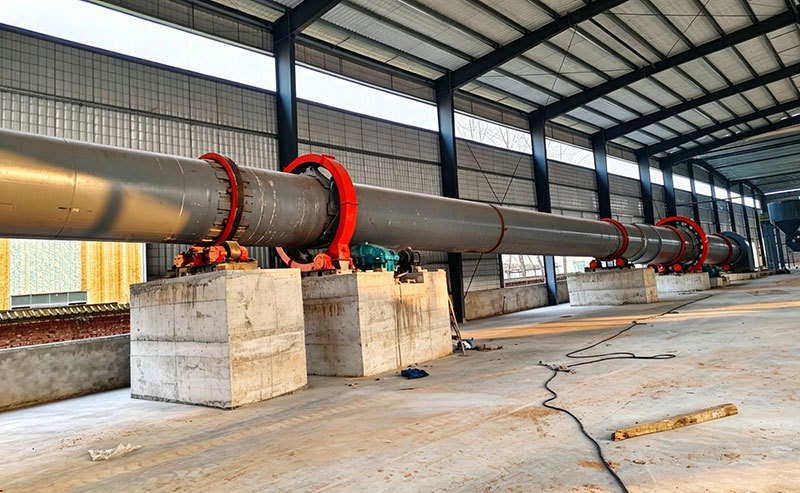
I. How Shell Sealing Is Achieved in Chemical Rotary Kilns
The sealing challenge of chemical rotary kilns lies in the fact that the shell continuously rotates at high temperature while experiencing axial movement, radial runout, and thermal expansion deformation, whereas the kiln hood is stationary. The sealing device must establish a reliable and durable barrier between "motion" and "stillness."
1. Mainstream Sealing Structure Types
There are currently three main types of sealing used in industry:
Labyrinth seals: Formed by staggered arrangement of rotating and stationary rings to create a tortuous path, increasing resistance to gas leakage. Simple structure, no contact wear, but limited compensation capability for micro-gaps, usually serving as the base layer of composite seals.
End-face contact seals: The sealing surfaces of the rotating and stationary rings press directly against each other, with compression force applied by springs, counterweights, or cylinders. Good sealing performance, but friction and wear exist on the sealing surface, requiring compensation mechanisms to maintain contact pressure.
Air chamber seals: An annular air chamber is set in the stationary ring, injecting gas through distribution slits onto the shell surface to form an air curtain, blocking gas exchange between the inside and outside of the kiln. Non-contact sealing, no wear, but requires a stable gas source.
2. Spherical-Conical End-Face Seal: A Highly Adaptive Solution
To address the large dynamic deviations of chemical rotary kilns, an improved sealing design adopts a spherical-conical mating end-face sealing pair: the sealing surface of the rotating ring is spherical, and the sealing surface of the stationary ring is conical (or vice versa), with the spherical surface always within the conical surface's wrapping range, the two contacting and rotating relative to each other.
The core advantage of this design is adaptive capability. The spherical surface has a certain radius of curvature, providing automatic self-aligning and self-centering functions, capable of adapting to axial displacement, radial runout, angular deviation, and coaxiality errors during rotary kiln operation. Meanwhile, the stationary ring is elastically connected to the kiln hood through a compensator, combined with an axial force-applying assembly (hydraulic cylinder, pneumatic cylinder, or spring), enabling the stationary ring to maintain continuous tracking of the rotating ring. Even if the rotating ring displaces due to thermal expansion or axial movement, the sealing surface still maintains contact.
For chemical materials, this seal has an additional value: an oil injection hole can be provided on the stationary ring to inject lubricant onto the sealing surface, both reducing friction and wear and forming a liquid film on the sealing surface to further block material leakage.
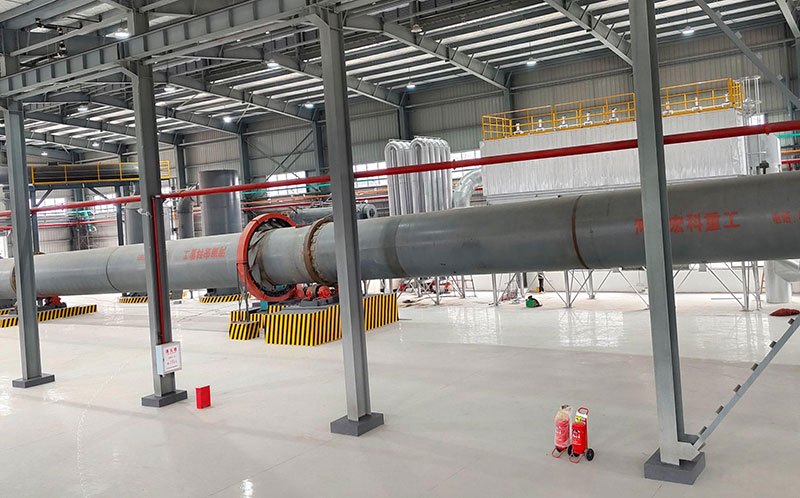
3. Engineering Practice of Composite Sealing
A single sealing form often struggles to cope with the complex working conditions of chemical rotary kilns. In actual engineering, a labyrinth + air chamber + flexible pressure plate composite structure is often used: the labyrinth structure extends the leakage path, the air chamber forms an air curtain to block the gas channel, and the flexible pressure plate (such as graphite blocks or leaf springs) fits against the shell surface as the last line of defense. For scenarios with prominent kiln head material leakage, a labyrinth baffle can also be added inside the kiln to slow material escape, and an adjustable-clearance flexible sealing gasket can be used outside the kiln head, with compression springs adapting to the shell's axial movement.
II. What Are the Criteria for Fuel Selection in Chemical Rotary Kiln Equipment
Fuel selection for chemical rotary kilns cannot simply compare calorific value per unit price. It requires comprehensive evaluation from three dimensions: process compatibility, operational economics, and environmental compliance.
1. Process Compatibility: Is the Fuel "Compatible" with Your Chemical Reaction?
Unlike ordinary heating equipment, chemical rotary kilns are mostly directly heated, with flames and combustion products directly contacting materials. This means the chemical composition of the fuel becomes part of the process.
Pulverized coal has a calorific value of approximately 7,000 kcal/kg and is low in price, but sulfur in coal reacts with materials to form sulfates, contaminating the product; ash also physically mixes into materials, affecting purity. For chemical products sensitive to impurities, pulverized coal may not be suitable.
Natural gas has a calorific value of approximately 8,500 kcal/m³, burns cleanly with no ash, and does not introduce solid impurities. However, its combustion produces water vapor that changes the humidity of the kiln atmosphere. For certain chemical reactions sensitive to moisture, this effect needs to be assessed.
Heavy oil, although high in calorific value, contains trace metals such as vanadium that may poison catalysts or discolor products, requiring caution in fine chemical scenarios.
If the process has extremely high requirements for atmosphere purity, indirect heating is a more thorough solution—the combustion process occurs outside the shell, and flames and flue gas do not enter the material chamber, isolating fuel contamination of the product at the source. However, the thermal efficiency of indirect heating is typically lower than direct heating.
2. Operational Economics: Don't Look Only at Fuel Unit Price
Fuel economics must be compared within a full life-cycle cost framework. The unit calorific value cost of natural gas is typically lower than electric heating, but gas price fluctuations and pipeline coverage vary by region. Coal has obvious price advantages but requires supporting coal grinding, dust collection, and desulfurization/denitrification facilities, with initial investment and O&M costs to be included. Electric heating (especially electromagnetic induction heating) has higher initial equipment premiums, but thermal efficiency can reach 88%-95%, with no combustion components and low maintenance costs. For high-value-added products, the incremental cost may be recovered within 1.5-3 years through energy savings and yield improvement.
A frequently overlooked dimension is the impact of temperature control precision on product yield. Natural gas heating temperature fluctuations are typically ±15°C-30°C, while electromagnetic heating with closed-loop control can keep fluctuations within ±1°C-5°C. For chemical products such as activated magnesium oxide and lithium battery materials that require high crystal phase consistency, differences in temperature control precision may directly determine whether the product is qualified.
3. Environmental Compliance: Emission Indicators Are Hard Constraints
Coal combustion produces SO₂, NOx, and dust, requiring supporting desulfurization, denitrification, and dust removal facilities, and is subject to fuel control policies in many regions. Natural gas NOx emissions can be controlled below 200 mg/m³ with low-NOx burners, with less environmental pressure. Electric heating achieves zero emissions, and in regions with strict environmental supervision or high carbon taxes, this advantage can translate into compliance costs and brand premiums.
4. Decision Framework for Fuel Selection
In summary, fuel selection for chemical rotary kilns should follow this judgment sequence:
Step 1: Process veto. If the fuel's chemical composition (sulfur, ash, heavy metals, moisture) would contaminate the product or interfere with the reaction, eliminate it directly. This is a non-negotiable bottom line.
Step 2: Temperature control matching. The product's tolerance for temperature uniformity and fluctuation range determines whether a high-precision heat source is needed. Rough calcination can accept natural gas, while fine chemicals may require electric heating or indirect heating.
Step 3: Cost accounting. Among the fuels that pass the first two steps, compare full life-cycle costs—including fuel unit price, supporting equipment investment, maintenance costs, and energy efficiency.
Step 4: Compliance verification. Confirm whether the selected fuel can be sustainably used under local environmental policies, avoiding forced retrofits after commissioning due to emission non-compliance.
Sealing and fuel selection in chemical rotary kilns are essentially management of "boundary conditions." Sealing manages the material exchange boundary between the inside and outside of the kiln, while fuel selection manages the compatibility boundary between heat input and product purity. Neither has a universal "optimal solution"—only a "matching solution" for specific materials, specific operating conditions, and specific regulations.
Henan Hongke Heavy Industry's mineral processing equipment enjoys significant competitive advantages in the industry. We provide one-stop full-chain services covering pre-sales consultation, in-process follow-up, and after-sales support, ensuring every customer buys with confidence and uses with peace of mind. Click Customer Service Consultation to leave us a message. You are welcome to visit Henan Hongke for on-site inspection and business negotiation. We will provide you with professional solutions and quotations!