

Air Duct Optimization and Product Uniformity Assurance for Magnesium Oxide Rotary Kilns
In magnesium oxide calcination production, air duct design and product uniformity are two tightly coupled core issues. Air duct design determines whether heat can be uniformly transferred to every position in the material bed, while product uniformity is the result of the combined effects of heat distribution, material movement, and residence time. Improper air duct design—localized overheating or underheating—directly manifests as product activity fluctuations and uneven crystal grains. If the material movement state inside the kiln does not match the airflow, even the best air duct design cannot deliver results.
I. How to Optimize Air Duct Design in Magnesium Oxide Rotary Kilns to Ensure Uniform Heating
The calcination temperature of magnesium oxide rotary kilns is typically between 800-950°C (light-burned magnesium oxide), with some processes reaching 1100-1300°C. This temperature range is extremely sensitive to atmosphere and temperature uniformity—excessively high temperatures cause over-burning and deactivation of magnesium oxide, while excessively low temperatures result in incomplete decomposition. The core goal of air duct design is to create a uniformly covering, controllable, and adjustable thermal field between air and fuel inside the kiln.
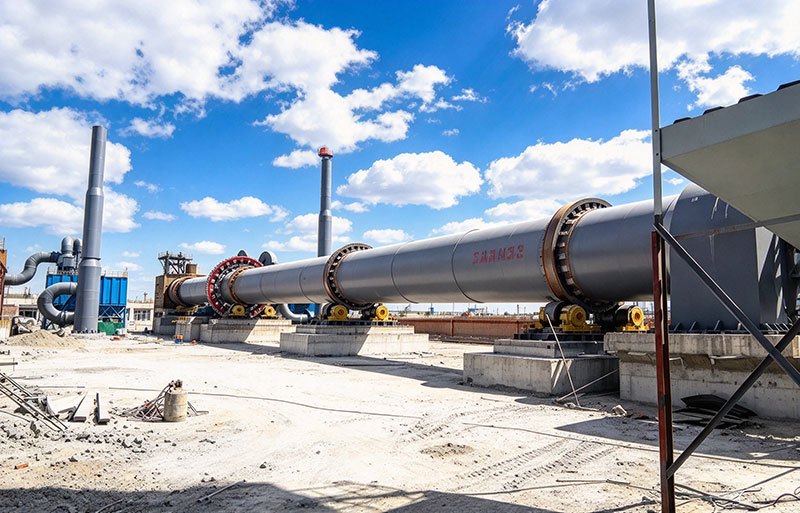
1. Matching Air Duct Layout with Material Flow
The distribution of air ducts must consider the flow direction of materials inside the kiln to ensure that air can fully contact the materials. Magnesium oxide materials move axially from the kiln tail to the kiln head inside the rotary kiln while tumbling in the circumferential direction. If air ducts are concentrated only on one side or in a localized area, the airflow will form a "short circuit" above the material bed and cannot penetrate the bed.
A reasonable approach is to adopt a circumferential multi-point, axially segmented air distribution method, creating relatively uniform coverage of the airflow across the kiln cross-section. For longer kiln shells, adjustable dampers or valves should be installed at different axial positions so that air volume can be adjusted in real time according to the temperature and reaction state of materials in each section.
2. Precise Control of Burner Position and Flame Shape
The burner is the "source" of the air duct system. The burner should be positioned appropriately so that the flame can uniformly cover the entire material bed. For light-burned magnesium oxide, the ideal flame form is short flame, soft fire, wide temperature zone, with flame length controlled at 8-15 m, without directly impinging on the kiln lining and material surface.
Flame shape adjustment depends on the reasonable matching of internal and external air flows. Increasing external air flow lengthens the flame, suitable for situations requiring an extended calcination zone; increasing internal air flow makes the flame short, thick, and dispersed, easily causing localized overheating and kiln coating erosion. During operation, the ratio of internal to external air flow should be dynamically adjusted according to material temperature and kiln coating condition, avoiding flame "sweeping the kiln coating" or "impinging on the material bed."
3. Linkage of Multi-Stage Combustion and Temperature Monitoring
Installing multiple burners at different positions on the kiln shell to achieve multi-stage combustion allows better control of temperature distribution and ensures uniform heating of materials throughout the process. Another advantage of multi-stage combustion is that when temperature deviation occurs in a certain section, it can be locally corrected by adjusting the load of that section's burner without changing the thermal regime of the entire kiln.
Temperature monitoring is the basis for air duct adjustment. Thermocouples and temperature sensors installed at key positions on the kiln shell collect temperature data from each section in real time, and this data is used to provide feedback for adjusting air volume and burner settings. For light-burned magnesium oxide, temperature fluctuations should be controlled within ±5°C to ensure stable magnesium oxide activity (activity ≥40 mg/g). Intelligent temperature control systems can improve control precision to ±2°C, which is decisive for improving product uniformity.
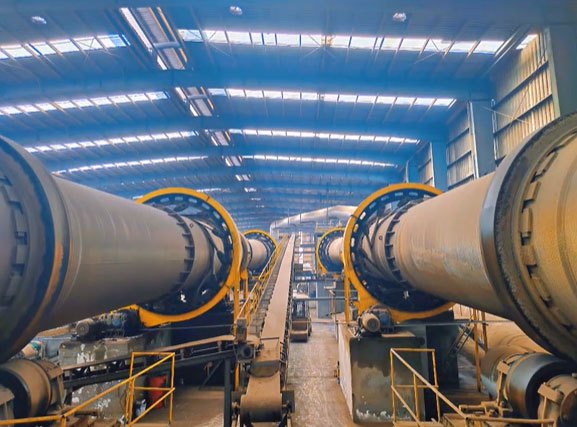
4. Reasonable Design of Air Duct Shape and Dimensions
The shape and dimensions of air ducts must be determined according to kiln shell specifications and material characteristics. Air ducts that are too narrow cause excessively high local air velocity and concentrated heat, leading to localized overheating; air ducts that are too wide disperse the airflow and cannot form effective penetration and mixing. During design, the optimal air duct cross-section and outlet angle should be determined through calculation and testing while ensuring air volume requirements.
II. How to Ensure Magnesium Oxide Product Uniformity
Air duct optimization solves the problem of "whether heat is uniform," while product uniformity also requires solving the problem of "whether materials consistently receive heat." The two must work in coordination.
1. Particle Size Control in Raw Material Pretreatment
Uneven raw material particle size is a major enemy of product uniformity. Coarse and fine particles have different heating rates, decomposition times, and residence states inside the kiln—fine particles heat up quickly and are prone to over-burning, while coarse particles heat up slowly and are prone to under-burning. Therefore, raw materials should undergo fine crushing and screening to ensure uniform kiln feed particle size.
For the process of producing magnesium oxide by calcining magnesium hydroxide, the raw material particle size is typically controlled at ≤10 mm. Some processes require finer sizes: magnesite needs to be ground to 200-mesh powder to increase specific surface area, enabling thorough calcination and shortened cycles.
2. Uniform Material Distribution in the Feeding System
The distribution state of materials inside the kiln directly affects heating uniformity. If materials accumulate on one side or are locally concentrated during feeding, even the best air duct design cannot ensure that every particle receives the same heat. Screw conveyors or other uniform distribution devices should be used to ensure that materials are evenly spread across the kiln cross-section.
Feed rate stability is equally critical. Fluctuating feed rates change the material bed thickness and material filling rate inside the kiln, thereby affecting airflow penetration and heat transfer efficiency. Stable feeding is the prerequisite for a stable thermal regime.
3. Matching Kiln Shell Speed with Residence Time
Kiln shell speed determines the material tumbling frequency and axial movement speed inside the kiln. If speed is too low, material tumbling is insufficient, and the temperature difference between the interior and surface of the material bed increases; if speed is too high, material residence time is shortened, and calcination is insufficient.
For magnesium oxide calcination, residence time needs to be precisely set according to the target product type. Taking the production of ultrafine flake magnesium oxide from magnesium hydroxide as an example, material residence time is typically controlled at 30-40 minutes, rotary kiln speed at 20-25 r/min, and feed rate at 17-20 mm/min. Only under this parameter combination can products with stable crystal form and uniform particle size be obtained.

4. Uniform Cooling in the Cooling System
Uniform cooling after calcination also affects product consistency. If cooling rates are inconsistent, some materials may develop cracks or phase transformation differences due to rapid cooling, causing fluctuations in the activity and particle size distribution of the final product. Designing an effective cooling system to ensure uniform cooling of calcined materials is the final link in ensuring product uniformity.
5. Closed-Loop Regulation by Intelligent Control Systems
Modern magnesium oxide rotary kilns are capable of integrating air ducts, combustion, feeding, and speed into unified control. Through DCS system linkage with kiln head infrared temperature measurement and kiln tail gas analysis (O₂/CO/CO₂), real-time adjustment of air-coal ratio, flame shape, and kiln speed keeps the calcination zone in a stable state. This closed-loop control integrates "uniform air ducts" and "uniform products" from two independent goals into the same control logic—using a uniform thermal field, combined with consistent material movement, to obtain uniform products.
Air duct design and product uniformity assurance in magnesium oxide rotary kilns are essentially two sides of the same issue. Air ducts solve "where heat comes from and where it goes," while material movement solves "where the material is and how long it stays." When the two are properly matched, the temperature history experienced by every magnesium oxide particle inside the kiln tends to be consistent, and the activity, crystal grains, and batch stability of the product are ensured.
Henan Hongke Heavy Industry's mineral processing equipment enjoys significant competitive advantages in the industry. We provide one-stop full-chain services covering pre-sales consultation, in-process follow-up, and after-sales support, ensuring every customer buys with confidence and uses with peace of mind. Click Customer Service Consultation to leave us a message. You are welcome to visit Henan Hongke for on-site inspection and business negotiation. We will provide you with professional solutions and quotations!