

Analysis of the Combustion System in Active Lime Rotary Kilns and a Guide to Refractory Brick Repair
In active lime production, the rotary kiln's combustion system and refractory brick lining are the two core elements that determine whether the kiln can operate stably over a long period. The combustion system is responsible for providing a controllable high-temperature flame, while the refractory bricks serve as the "armor" against high-temperature erosion. The following sections analyze these two aspects separately.
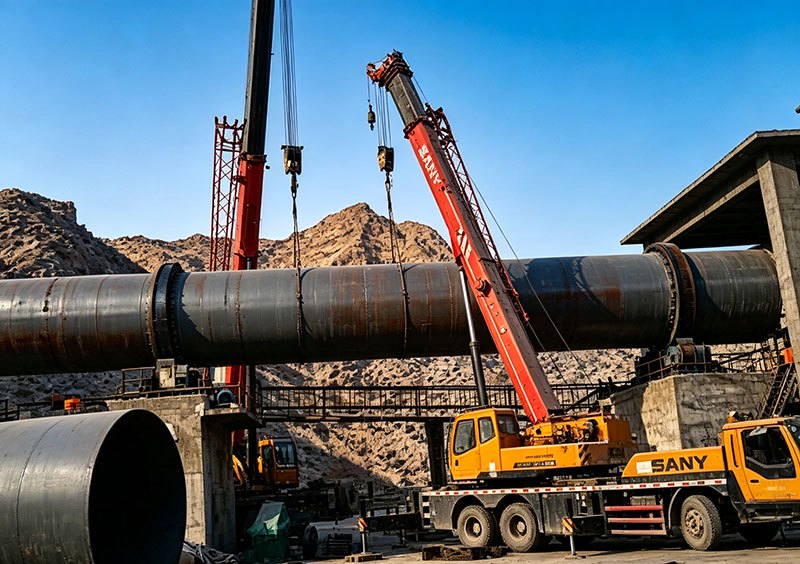
I. Combustion System of an Active Lime Rotary Kiln
The combustion system of an active lime rotary kiln typically consists of four parts: fuel supply, combustion air supply, burner body, and safety control. Its design goal is to form a flame with controllable temperature and stable shape inside the kiln.
1. Structure and Types of Burners
The burner (nozzle) is fixed on the kiln head hood and is the core component of the combustion system. Depending on the fuel type and kiln specifications, two-channel, three-channel, or four-channel burners are commonly used.
Taking a four-channel burner for mixed coal and gas combustion as an example, its structure consists of multiple concentric sleeves: the central pipe introduces primary air, while the outer sleeves introduce mixed gas or pulverized coal. Spiral guide vanes between the air channels cause the fuel and air to form swirling or straight flows, achieving more uniform mixed combustion. The burner tip is usually made of heat-resistant cast steel, with key components using high-temperature ceramic elements to ensure service life under the high-temperature radiation at the kiln head.
2. Distribution and Role of Combustion Air
Combustion air is divided into primary air and secondary air, supplied separately by independent fans.
Primary air directly participates in combustion and controls the flame shape through its injection velocity, while also providing cooling protection for the burner. The total flow and pressure of primary air must be precisely controlled; generally, the primary air volume must not be less than 10% of the total air volume.
Secondary air comes from the cooler. During lime cooling, it is heated to approximately 600°C and enters the kiln as high-temperature combustion air to participate in combustion. This design fully utilizes the sensible heat of the lime, significantly reducing fuel consumption.
3. Methods for Adjusting Flame Shape
Flame shape adjustment is the key to combustion system operation. By adjusting the ratio of axial flow and radial flow in the primary air, the length and width of the flame can be changed:
To increase flame length: reduce radial air, increase axial air
To increase flame width: reduce axial air, increase radial air
To obtain a "soft flame": reduce both axial and radial air simultaneously
During normal production, the kiln head should maintain negative pressure (-10 to -20 Pa) to ensure good ventilation and sufficient heat transfer inside the kiln. When an excessively long flame causes ring formation at the rear of the burning zone, the distribution of axial and radial flow can be appropriately adjusted to ensure complete combustion of pulverized coal and control the flame shape.
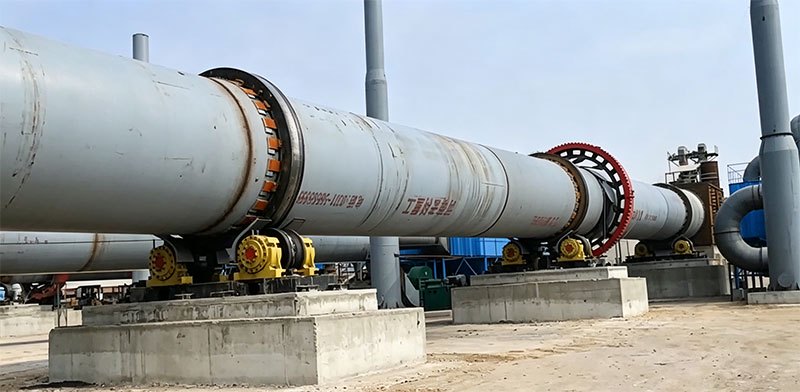
II. Causes of Refractory Brick Damage in Rotary Kilns
Refractory brick damage is usually not caused by a single factor but is the result of the combined effects of mechanical stress, thermal stress, and chemical erosion.
Mechanical stress is a problem unique to rotary kilns. As the kiln shell rotates, bricks at the support roller positions are compressed, while bricks at the top of the shell are stretched. The brick lining withstands combined mechanical stresses of compression, tension, torsion, and shear. When the clearance between the tire and shell is too large, causing increased ovality, the alternating stresses on the lining bricks are significantly intensified.
Thermal stress mainly comes from rapid heating and cooling. Frequent kiln startups and shutdowns or rapid cooling cause thermal fatigue in refractory bricks with high expansion coefficients, leading to surface spalling and cracking.
Chemical erosion is related to alkali metals, sulfur, and other components in raw materials and fuels. When these substances penetrate the brick body, they deteriorate the brick structure.
III. Repair Methods for Refractory Brick Damage
Refractory brick repair should be handled according to the degree of damage: for localized damage, gunning or patching is preferred; for structural instability, sectional or full re-bricking is required.
1. Local Rapid Repair (Hot/Cold)
Gunning (preferred for hot repair) : Use refractory gunning material (high-alumina, mullite, magnesia), air pressure 0.2-0.3 MPa, distance 200-250 mm, angle 30-45°, layered spraying (each layer <7 mm), spray again after drying, until slightly below the original surface.
Patching/brick insertion: Suitable for small-area spalling. Cut the damaged area neatly, clean the interface, and insert new bricks in a staggered pattern with full mortar.
Injection/grouting repair: For deep cracks or delamination, mechanically inject refractory slurry or mastic for dense filling.
2. Castable Repair Method
For areas with large refractory material loss, the anchor + castable repair method can be used. The specific steps are: clean the fallen area and surrounding kiln coating to expose the unburned brick surface; drill holes in the bricks to fix expansion bolts, and weld tie bars between adjacent bolts to form a fixed structure; then pour refractory castable. The castable height should be 10-20 mm lower than the normal refractory brick height, and the outer layer can be sprayed with heat-resistant coating.
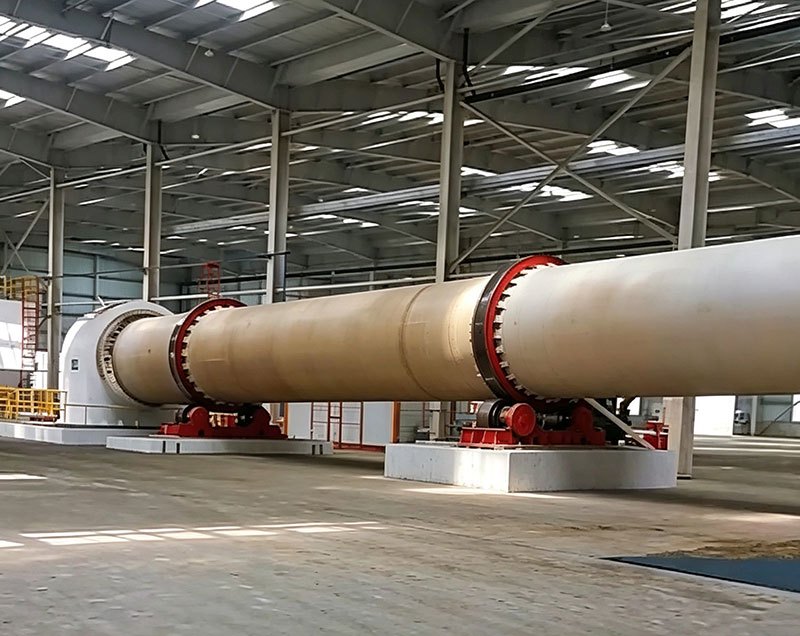
3. Sectional/Full Re-bricking (Cold Major Overhaul)
When localized severe erosion or structural instability occurs, sectional demolition and re-bricking are required. Material selection must match the working conditions of the specific zone: high-temperature burning zone (1200-1600°C) uses high-alumina bricks (Al₂O₃ 75-90%), mullite bricks, or corundum bricks; transition zone/preheating zone uses clay bricks, high-alumina bricks, or lightweight insulating bricks.
Core masonry points include: staggered brickwork, strictly prohibiting continuous joints; joint thickness controlled at 1-1.5 mm (precision) or ≤2 mm (standard), with mortar fullness ≥95%; expansion joints every 5-8 m, filled with ceramic fiber rope.
4. Post-Repair Curing and Kiln Drying
Regardless of the repair method used, execution of the kiln drying curve is the key link determining the repair effect. After castable construction, it must be cured at appropriate temperature and humidity for sufficient time to gain initial strength, and then physical water and crystal water are removed according to a scientifically established heating curve. Too rapid heating will cause the new lining to crack, wasting all the repair work.
Henan Hongke Heavy Industry's mineral processing equipment enjoys significant competitive advantages in the industry. We provide one-stop full-chain services covering pre-sales consultation, in-process follow-up, and after-sales support, ensuring every customer buys with confidence and uses with peace of mind. Click Customer Service Consultation to leave us a message. You are welcome to visit Henan Hongke for on-site inspection and business negotiation. We will provide you with professional solutions and quotations!