

Speed Control and Temperature Uniformity Solutions for Bauxite Rotary Kilns
In bauxite calcination production, rotation speed and kiln temperature distribution are two coupled core operating variables. Rotation speed determines the material residence time and tumbling frequency inside the kiln, while temperature uniformity determines whether the bauxite can complete sufficient dehydration and crystal form transformation. There is a direct causal chain between the two: improper speed aggravates uneven temperature distribution, and temperature imbalance in turn limits the adjustment space for speed.

I. Impact of Speed Changes on Calcination Performance
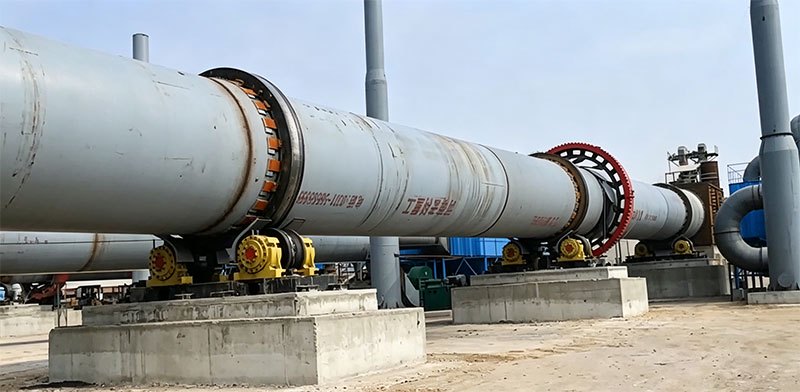
The rotation speed of a bauxite rotary kiln is typically adjustable within the range of 0.3 to 2.5 r/min, with the specific value depending on kiln shell specifications and process requirements. Faster or slower speeds produce completely different effects on calcination performance.
1. Hazards of Excessive Slowness
When the kiln shell rotation speed is too low, the material tumbling frequency inside the kiln is insufficient, the temperature difference between the interior and surface of the material bed increases, and heat exchange efficiency drops significantly. Specifically: heat transfer between the material and hot gas flow is insufficient, the raw material shadow approaches the kiln head, and "raw material running" easily occurs—that is, insufficiently calcined material is discharged from the kiln prematurely.
For viscous materials such as bauxite, excessively slow speed also aggravates material adhesion to the kiln inner wall. If not detected and adjusted in time, the adhesion layer gradually thickens, and with increased firing power, forms solid rings or blockages. The resulting clinker often has a yellow color, and both alumina content and bulk density fail to meet standards. In addition, when speed is too slow, the material bed inside the kiln is thicker. Even if coal feed is increased, the burning zone temperature recovers slowly, making short-flame forced burning likely, producing yellow-core material, with large amounts of unburned pulverized coal falling into the material bed and causing incomplete combustion.
2. Hazards of Excessive Speed
Excessively fast rotation speed is equally detrimental to calcination quality. The material residence time inside the kiln is compressed, calcination time is insufficient, alumina crystal development is incomplete, impurities are not fully removed, and product quality is seriously affected. From a heat transfer perspective, when speed is too high, the material is quickly carried toward the kiln head. Although the temperature distribution across the material bed cross-section tends to be uniform, the overall heating time is insufficient for complete physical and chemical reactions.
3. Dialectical Relationship Between Speed and Heat Transfer Efficiency
There is an optimal range for the effect of speed on heat transfer efficiency. When kiln shell speed increases within a reasonable range, the number of material tumblings inside the kiln increases, the surface area exposed to high-temperature gas flow increases, the temperature distribution across the material bed cross-section becomes more uniform, and heat transfer efficiency improves accordingly. This is the physical basis for the industry experience that "increasing speed can reduce fuel consumption."
However, this effect has an upper limit. When speed exceeds a certain critical value, the material residence time inside the kiln drops sharply, and the improvement in heat transfer efficiency cannot compensate for the loss of calcination time, causing product quality to decline. Therefore, the essence of speed adjustment is finding a balance between "heat transfer efficiency" and "residence time."
4. Principles for Reasonable Speed Setting
The speed setting of a bauxite rotary kiln must be considered in coordination with the kiln shell inclination angle and feed rate. Under a certain inclination, the higher the speed, the faster the material tumbles inside the kiln, and the feed rate should be correspondingly reduced; otherwise, combustion will be incomplete. In industry practice, kiln speed and feed rate are theoretically proportional, but the optimal matching ratio for each kiln must be determined through trial operation.
Taking a certain bauxite calcination process as an example, when the kiln shell speed is maintained at 2.3 r/min, the material residence time inside the kiln is approximately 40 to 45 minutes, the kiln head temperature is controlled at 840 to 880°C, and the kiln tail temperature is controlled at 520 to 560°C, yielding products of stable quality.
II. Causes and Countermeasures for Uneven Temperature Inside the Kiln
1. Analysis of Causes of Temperature Non-Uniformity
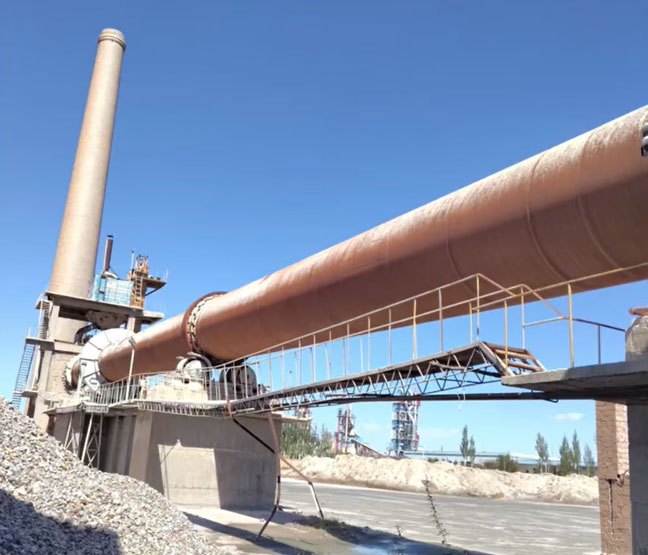
Uneven temperature distribution inside the kiln is an inherent characteristic of rotary kilns. Its causes include:
Flame shape and position deviation: Burner flames that are too long, too short, or biased toward the kiln wall all cause localized overheating or underheating. A flame directly impinging on the material surface causes localized overheating, while a dispersed flame prevents heat concentration.
Inconsistent material movement state: When speed and inclination do not match, the material moves too fast or too slow in a certain section of the kiln, causing the thermal load in that section to deviate from the design value.
Ring formation or coating spalling inside the kiln: Ring formations obstruct normal material flow, causing upstream material accumulation and downstream material shortage, creating axial sudden changes in temperature distribution.
Improper combustion air distribution: An imbalanced ratio of primary and secondary air affects flame combustion efficiency and length, thereby affecting temperature distribution.
2. Control Measures for Temperature Uniformity
Measure 1: Optimize burner flame shape
Control the length and width of the flame by adjusting the axial and radial flow ratios of the burner. The key to uniform heat distribution inside the kiln lies in reasonable control of flame shape, avoiding excessively high or low temperature zones. When localized high temperature occurs inside the kiln, appropriately increase the radial air ratio to widen the flame and flatten the temperature; when the overall kiln temperature is low, increase the axial air ratio to lengthen the flame and drive heat deeper into the middle of the kiln shell.
Measure 2: Establish temperature monitoring and feedback control system
Use thermocouples or infrared thermometers to monitor temperatures at different parts of the kiln, feeding signals back to the control system to automatically adjust heating power, feed rate, and other parameters. For large rotary kilns, wireless temperature transmitters can be installed on the kiln shell surface to monitor kiln shell temperature distribution in real time, promptly detecting localized overheating or underheating zones. Practice at a Russian alumina plant showed that after adopting a wireless temperature monitoring solution, non-specification products were reduced by 96 tons per year, and maintenance frequency and operating costs were significantly reduced.
Measure 3: Coordinated adjustment of speed and feed rate
When axial deviations in kiln temperature distribution occur, fine-tuning the speed can adjust the thermal load of materials in each temperature zone. For example, when the burning zone temperature is low, appropriately reduce speed to extend material residence time in the high-temperature zone; when the preheating zone temperature is high, appropriately increase speed to make material pass through that zone faster. However, speed adjustments should be carried out smoothly, avoiding frequent large changes that disrupt the stability of the thermal regime.
Measure 4: Stabilize feed and kiln conditions
Fluctuations in feed rate are an important cause of uneven temperature. Feed speed should be kept stable, using buffer bins or metering devices to ensure uniform material input into the kiln. When ring formation or coating spalling occurs inside the kiln, operating parameters should be adjusted in time, and speed reduced if necessary to slow material flow and prevent severe temperature fluctuations caused by ring collapse.
Measure 5: Optimize excess air coefficient
The excess air coefficient has a significant impact on burning zone temperature and length. Mathematical model studies show that when the excess air coefficient decreases from 1.38 to 1.20, the burning zone temperature rises and length shortens; when further reduced to 1.10, the burning zone temperature instead drops and length increases. This means there is an optimal excess air coefficient range that keeps the burning zone temperature both sufficiently high and reasonably distributed. During operation, the kiln tail excess oxygen content should be controlled within a stable range of 0.4% to 2.5%.
3. Preventive Management of Temperature Non-Uniformity
The maintenance of temperature uniformity largely depends on the stability of kiln conditions. A stable feed rate is the foundation for stable rotary kiln operation. If feed changes or feed composition changes are not anticipated by the operator, temperature cycling fluctuations will result. Dust recovery should also be kept stable through buffer bins or metering devices.
When a "cycling" phenomenon occurs inside the kiln—that is, the burning zone temperature repeatedly fluctuates up and down even after operator adjustment—it indicates that the system has entered an unstable state. At this point, the rate of fuel change should be slowed, and production reduced if necessary to prevent further deterioration of kiln conditions.
Speed control and temperature uniformity management in bauxite rotary kilns are not two independent technical issues. Speed determines the material movement trajectory and residence time inside the kiln, while temperature distribution determines the degree to which the material receives sufficient heat at different positions. Using speed as a means of adjusting temperature uniformity, and using temperature distribution feedback to guide speed optimization, is the core operating logic for achieving high-quality bauxite calcination.
Henan Hongke Heavy Industry's mineral processing equipment enjoys significant competitive advantages in the industry. We provide one-stop full-chain services covering pre-sales consultation, in-process follow-up, and after-sales support, ensuring every customer buys with confidence and uses with peace of mind. Click Customer Service Consultation to leave us a message. You are welcome to visit Henan Hongke for on-site inspection and business negotiation. We will provide you with professional solutions and quotations!