

Refractory Brick Replacement Cycles in Metallurgical Rotary Kilns and the Importance of Kiln Atmosphere Control
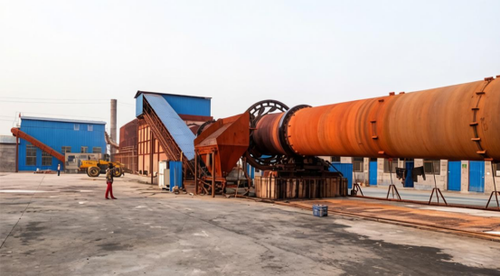
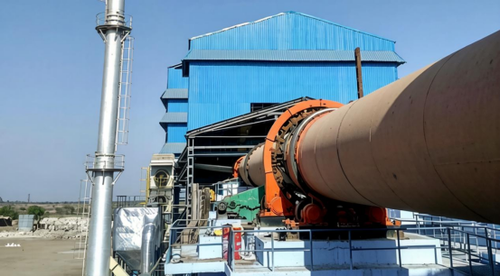
In the operation and management of metallurgical rotary kilns, the refractory brick replacement cycle and kiln atmosphere control are two core issues that determine whether production can continue stably. Refractory bricks are the "armor" that protects the kiln shell against high temperature, chemical erosion, and mechanical wear, and their service life directly determines the kiln's maintenance frequency and operating costs. Kiln atmosphere determines the direction and efficiency of metallurgical reactions; improper atmosphere control not only affects product quality but also accelerates refractory brick damage. There is a close relationship between the two: loss of atmosphere control often leads to localized high temperatures or intensified chemical erosion, thereby shortening the actual service life of refractory bricks.
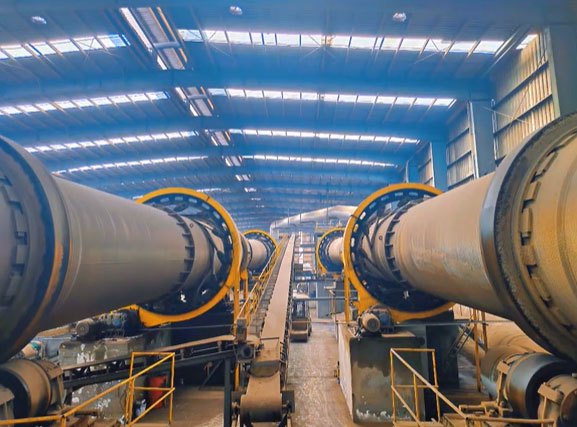
I. Refractory Brick Replacement Cycles in Metallurgical Rotary Kilns
1. Service Life Differences Across Different Zones
Refractory bricks in metallurgical rotary kilns are not replaced uniformly throughout the kiln. Instead, they exhibit a significant service life gradient according to the different working conditions in each zone.
From the kiln head discharge end backward approximately 30 meters—the high-temperature zone—is the area with the most severe working conditions. This zone withstands the highest temperatures, the most severe chemical erosion, and material scouring, with continuous full-load service periods without maintenance of only 10 to 360 days. From 30 meters backward to the kiln tail feed end—the medium and low-temperature zone—working conditions are relatively mild, with service life reaching 60 to 1,500 days.
Using cement rotary kilns as a reference, magnesia-alumina spinel refractory bricks in the burning zone typically last 6 to 18 months, transition zone or safety zone bricks can reach 1 to 3 years, and preheater and calciner bricks can reach 3 to 8 years or longer. Because metallurgical rotary kilns process more corrosive materials and require more complex atmosphere control, the actual service life of the high-temperature zone is often shorter than that of comparable zones in cement kilns.
2. Key Factors Affecting Replacement Cycles
The actual service life of refractory bricks is affected by multiple factors. Masonry quality is the foundation—improper brick joint control and unreasonable use of locking steel plates both create stress concentration and accelerate brick damage. In terms of kiln shell structure, shell deformation causes refractory bricks to bear additional mechanical stress. Operating factors are equally critical, including execution of the kiln drying heating curve, adjustment of flame shape, and stability of the kiln's thermal regime.
For metallurgical rotary kilns, chemical erosion is particularly prominent. Taking vanadium slag roasting as an example, the working conditions of the kiln lining in the high-temperature zone are extremely poor. Low-melting-point sulfides generated in the charge infiltrate the refractory material, causing it to expand and become porous, and it is subsequently washed away by the material. Chloric acid generated during chlorination roasting further aggravates the erosion and pulverization of refractory bricks under high-temperature and high-humidity conditions.
3. Principles for Determining Maintenance Cycles
Maintenance scheduling for metallurgical rotary kilns should follow the principle of "zonal assessment, condition-based replacement." After reaching the preset service life, a planned kiln shutdown should be carried out to inspect and re-evaluate the lining. Those requiring replacement should be replaced; those not requiring replacement should continue to be used.
An engineering practice worth noting is that by optimizing the refractory material combination and masonry process, linings originally lasting only 10 to 60 days can be extended to over 300 days. Practice at Ansteel's lime rotary kiln also showed that by changing the refractory material type and masonry method in the burning zone, the service life of that area was extended from 8 to 10 months to 18 to 24 months.
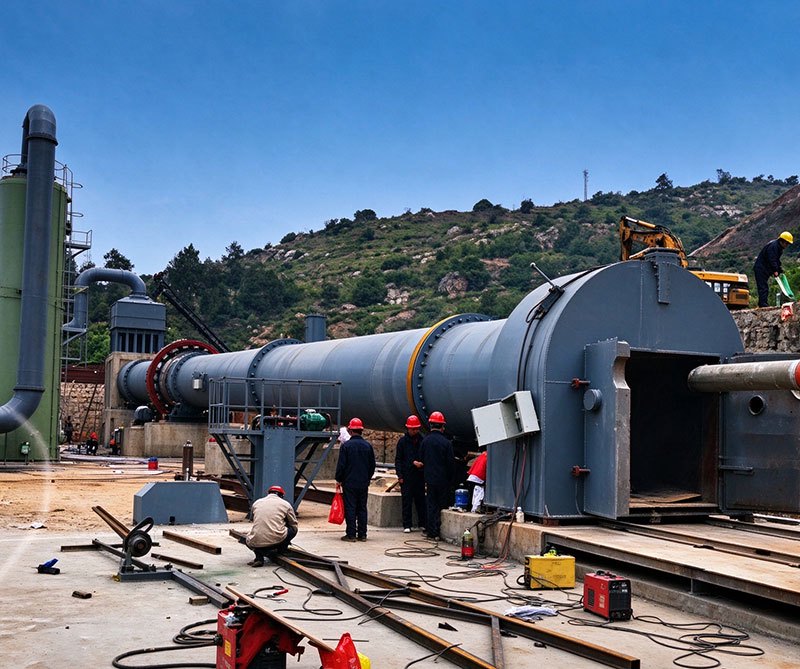
II. The Importance of Kiln Atmosphere Control
1. Atmosphere Control Determines the Direction of Metallurgical Reactions
The nature of the atmosphere inside the rotary kiln—whether oxidizing, reducing, or neutral—directly determines whether metallurgical reactions proceed in the expected direction. In the rotary kiln direct reduction process, the high-temperature reduction zone (950-1,100°C) requires the presence of large amounts of excess carbon, causing the gasification reaction to develop strongly, with very low CO₂ concentration in the reaction system, forming a nearly pure CO reducing environment.
The precision requirements for atmosphere control are extremely high. Taking vanadium slag oxidative roasting as an example, in patented technology, by adjusting the material bed thickness (1/10 to 1/20 of the kiln shell diameter) and controlling the air injection volume (0.1 to 2 times the gas volume), vanadium conversion rate was optimized from 90.8% to 92.1%. This case clearly demonstrates that small changes in atmosphere parameters produce measurable effects on reaction efficiency.
2. The Relationship Between Atmosphere Control and Refractory Brick Service Life
The impact of atmosphere control on refractory brick service life is often underestimated by operators. When localized areas of excessively strong reducing or oxidizing atmosphere appear inside the kiln, the softening temperature of materials and the fusion temperature of ash change. In direct reduction processes, if operating temperature must be increased to compensate for insufficient reducing agent reactivity, kiln lining adhesion failures are highly likely to occur.
Studies show that reducing agents with poor reactivity (such as anthracite and coke fines) require higher operating temperatures to achieve reduction rates, which significantly increases the risk of kiln lining damage. Switching to highly reactive lignite or sub-bituminous coal as the reducing agent allows operation at lower temperatures, significantly improving the reduction process and ensuring safe kiln operation.
3. The Decisive Role of Atmosphere Control in Product Quality
In metallurgical rotary kilns, product quality is far more sensitive to atmosphere than in ordinary calcination equipment. Taking direct reduced iron production as an example, the kiln atmosphere must maintain strong reducing conditions, with the CO/CO₂ ratio controlled at a high level, to ensure sufficient reduction of iron oxides. If atmosphere control is improper, already-reduced metallic iron may be re-oxidized, causing the metallization rate to decline.
Outside the protective layer on the material surface in the rotary kiln, the atmosphere is oxidizing or weakly oxidizing. To prevent re-oxidation of reduced iron, the reducing agent addition is usually greater than the theoretical amount. The poorer the reducing agent reactivity, the greater the excess required. Increasing the material filling rate inside the kiln not only increases material residence time but also, because more CO escapes from the material bed, provides better protection for the material bed surface, strengthens the reducing potential within the bed, and significantly benefits the reduction process.
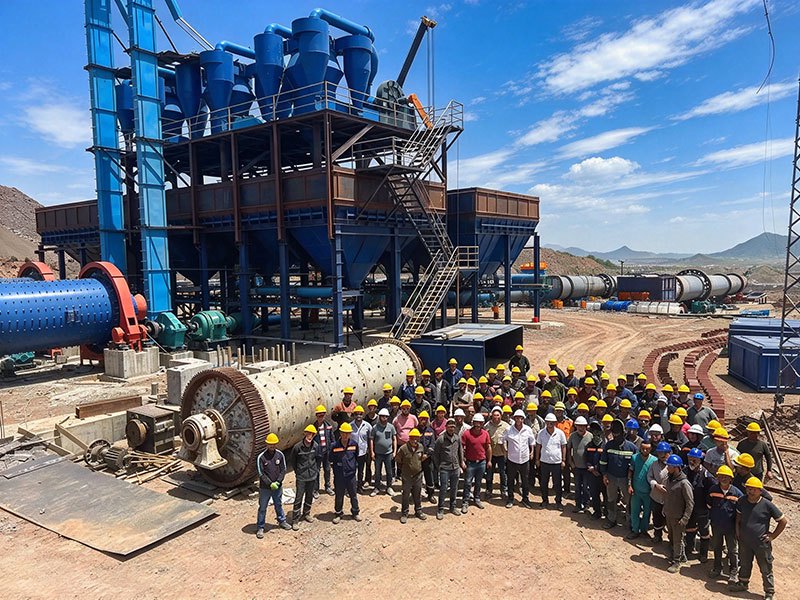
4. Modern Technical Means of Atmosphere Control
Modern atmosphere control in metallurgical rotary kilns has shifted from reliance on operating experience to precise automated regulation. A typical control method involves installing blowers and an equal number of burners on the kiln shell for air injection and combustion support, while real-time monitoring of atmosphere status through online CO/CO₂ analyzers provides feedback for adjusting coal blending ratio and secondary air volume.
For the rotary kiln direct reduction heat supply curve, advanced technical solutions include: installing cooling water spray guns and pulverized coal lances at the discharge end, adjusting the kiln shell inclination to 2%-3% and increasing speed to 0.5-1 r/min, maintaining the material filling rate inside the kiln at 15%-20%, and achieving more uniform temperature along the material bed thickness direction. By supplying combustion air to different positions inside the kiln through multiple kiln back fans, CO produced during iron ore reduction can continue to combust in the low-temperature zone, both raising the low-temperature zone temperature and improving overall thermal efficiency.
Refractory brick replacement and kiln atmosphere control in metallurgical rotary kilns are essentially two aspects of the same issue. The service life of refractory bricks determines how long the kiln can operate continuously, while the quality of atmosphere control determines whether refractory bricks can achieve their expected service life. Stable atmosphere is the prerequisite for refractory brick longevity, and intact refractory bricks are the foundation for controllable atmosphere. Incorporating both into the same operational logic is the fundamental path to achieving long-term stable operation of metallurgical rotary kilns.
Henan Hongke Heavy Industry's mineral processing equipment enjoys significant competitive advantages in the industry. We provide one-stop full-chain services covering pre-sales consultation, in-process follow-up, and after-sales support, ensuring every customer buys with confidence and uses with peace of mind. Click Customer Service Consultation to leave us a message. You are welcome to visit Henan Hongke for on-site inspection and business negotiation. We will provide you with professional solutions and quotations!