

Airflow Uniformity and Combustion Chamber Design in Zinc Oxide Rotary Kilns
In the actual operation of zinc oxide rotary kilns, uniform airflow distribution inside the kiln and reasonable combustion chamber design are two core technical links that determine calcination efficiency, product grade, and kiln lining service life. Uneven airflow distribution causes localized over-burning or under-burning inside the kiln, insufficient oxidation of zinc vapor, and fluctuations in product grade. Improper combustion chamber design directly affects complete fuel combustion, temperature field stability, and exhaust emission indicators.
I. How to Ensure Uniform Airflow Distribution Inside a Zinc Oxide Rotary Kiln
1. Air Inlet and Multi-Point Air Supply Design
Reasonable design of air inlet positions and sizes is the foundation of uniform airflow distribution. Air inlets must meet oxygen supply requirements while allowing air to enter the kiln evenly. The traditional single air inlet method easily leads to gas failing to distribute evenly inside the kiln—a common defect in current zinc oxide kiln gas supply processes.
Adopting multi-point air supply is an effective means of improving uniformity. Dispersing air entry through multiple inlets rather than a single inlet avoids localized overheating or undercooling inside the kiln, making temperature distribution more balanced. In actual engineering, fresh air is introduced by a high-pressure centrifugal fan at the kiln head, mixed with oxygen from the oxygen supply device, and blown into the kiln from the kiln head. At the same time, an induced draft fan is installed at the kiln tail product collection section, forming a complete air inlet and outlet system.
2. Application of Guide Vanes and Baffle Plates
Installing guide vanes or baffle plates inside the rotary kiln helps guide airflow direction, allowing air to cover the kiln cross-section more evenly. This measure is especially suitable for situations where the kiln shell is relatively long and gas easily flows along a fixed path, creating "short-circuiting."
3. Optimized Adjustment of Burner Position
Adjust the burner position according to the position and movement of materials inside the kiln to ensure uniform heat distribution. The burner of a zinc oxide rotary kiln is usually set at the kiln head. The flame shape and injection angle need to match the tumbling trajectory of materials inside the kiln, avoiding direct flame impingement on the material surface that causes localized high temperatures.
4. Variable-Diameter Kiln Shell Structure
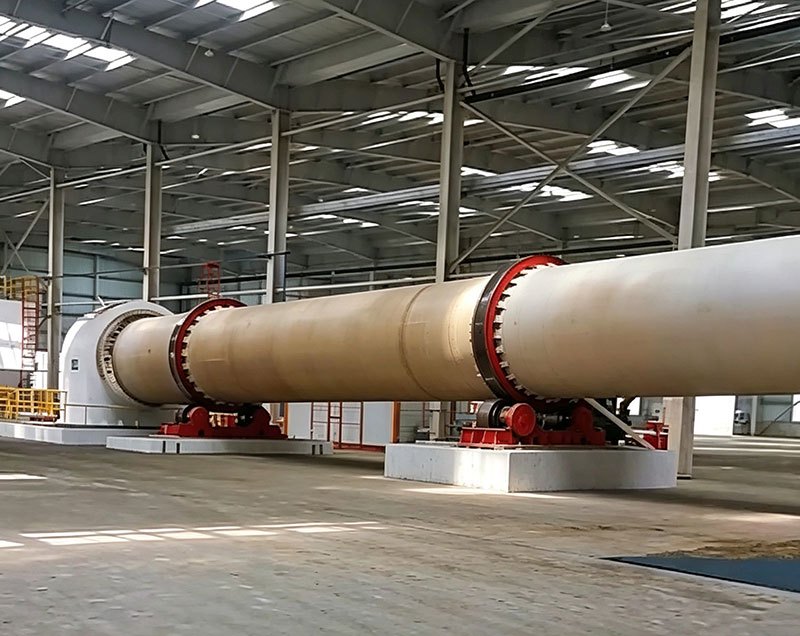
Adopting a variable-diameter rotary kiln, a variable-diameter structure is created through a transition in the middle section along the kiln shell length, making the internal space suitable for changes in gas volume. The principle of this design is: as gas passes through the kiln shell, its temperature gradually decreases and volume gradually shrinks. The variable-diameter structure prevents flames or high-temperature flue gas from gradually moving away from the incoming raw material surface along the process direction, facilitating radiation heat transfer in the high-temperature zone and convective heat transfer in the preheating zone, effectively preventing uneven temperature distribution and localized high temperatures inside the kiln.
In a variable-diameter kiln, the high-temperature section diameter is larger than the low-temperature section, making the relative linear velocity of material movement against the kiln wall in the high-temperature section greater than in the low-temperature section, and the contact time with the high-temperature section wall relatively shorter, which helps avoid overheating of fine particles. At the same time, the low-temperature section diameter is relatively smaller, and its actual filling rate is relatively higher, resulting in a better reducing atmosphere in the low-temperature section than in the high-temperature section, facilitating the reduction reaction. Compared with conventional constant-diameter rotary kilns, variable-diameter kilns can save approximately 20% energy.
5. Mixing Devices and Exhaust Optimization
Install a gas mixing device before the air inlet to ensure fuel and combustion air are fully mixed before entering the kiln. At the same time, optimize the exhaust system design to ensure the exhaust port can effectively discharge waste gas without causing pressure fluctuations inside the kiln.
6. Precise Control of Kiln Negative Pressure
The stability of kiln negative pressure is the prerequisite for uniform airflow distribution. If negative pressure is too high, more cold air enters, the reaction zone moves backward, the kiln tail temperature rises, and some unoxidized fine particles are carried into the flue gas, affecting product quality. If negative pressure is too low, the air volume inside the kiln is insufficient, the reaction zone moves forward, the oxidizing atmosphere weakens, and the reducing atmosphere strengthens,同样 affecting product quality.
In actual production, kiln negative pressure is generally controlled between -40 and -50 Pa, and rotary kiln speed is controlled at 1.5 to 3.0 min/r. Creating a certain negative pressure at the kiln head can maximize the prevention of flue gas escaping through the kiln head.
II. What to Consider in Combustion Chamber Design for Zinc Oxide Rotary Kilns
1. Ensure Complete Fuel Combustion
The primary goal of combustion chamber design is to achieve complete fuel combustion and reduce unburned fuel residue. For zinc oxide rotary kilns, the combustion chamber needs to provide a stable high-temperature environment while possessing good temperature adjustment capability to adapt to different raw materials and operating conditions.
2. Refractory Material Selection
Select appropriate refractory materials according to the combustion chamber's operating temperature to withstand high temperatures and maintain structural stability. The reaction temperature of zinc oxide rotary kilns is generally 1100-1300°C, and the kiln tail flue gas temperature is 650-750°C. The combustion chamber and high-temperature section of the kiln require refractory bricks capable of resisting high temperature and chemical erosion, such as magnesia-alumina-chrome bricks and high-alumina bricks.
3. Ventilation and Oxygen Supply
Ensure good ventilation in the combustion chamber to provide sufficient oxygen supply for the combustion process. The air volume introduced into the zinc oxide rotary kiln should ensure sufficient oxygen in the kiln flue gas to re-oxidize all previously reduced metal vapors, sulfides, and carbon monoxide. Increasing air volume extends the reduction zone toward the feed end, while decreasing air volume shortens the reduction zone and extends the starting section of the reduction zone toward the discharge end. This balance is the core consideration in combustion chamber ventilation design.
4. Burner Type Selection
Select the appropriate burner type according to the fuel properties (solid, liquid, or gas) and combustion characteristics. Zinc oxide rotary kilns typically use gas or pulverized coal as fuel, and the burner design needs to ensure controllable flame shape and high combustion efficiency. The combustion chamber shape design should facilitate complete fuel combustion while reducing heat loss.
5. Safety Protection and Maintenance Convenience
The design should consider the combustion chamber's ease of disassembly and maintenance convenience for regular inspection and cleaning. At the same time, necessary safety protection measures should be provided, such as designs to prevent flame leakage and effective exhaust gas purification systems.
6. Heat Energy Recovery and Utilization
Consider recovering and utilizing part of the heat energy generated by the combustion chamber to improve energy utilization efficiency. In actual engineering, the high-temperature flue gas discharged from the rotary kiln can pass through a secondary combustion chamber to burn incompletely combusted combustibles, then pass through a high-low temperature composite air heat exchanger to produce high-temperature hot air (500-700°C) and low-temperature hot air (300-400°C). High-temperature hot air can be used as high-temperature combustion air for the rotary kiln, while low-temperature hot air can be used for wet pellet drying or pellet preheating, effectively reducing fuel consumption.
7. Combustion Atmosphere Control
Zinc oxide production has special requirements for combustion atmosphere. Studies show that by alternately providing non-oxidizing (reducing) flames and oxidizing flames, the color and density of zinc oxide can be controlled. For example, maintaining non-oxidizing conditions for 6 minutes and oxidizing conditions for 4 minutes, alternating cycles typically provide good color with almost no densification. This atmosphere control requirement needs to be considered in combustion chamber design, achieved through automatic timed switching of air supply valves.
The airflow distribution and combustion chamber design of zinc oxide rotary kilns are essentially precise control of the balance among "air, coal, material, and temperature." Uniform airflow is the prerequisite for uniform temperature, uniform temperature is the foundation for stable product grade, and the combustion chamber is the source of it all. Only by ensuring complete fuel combustion and atmosphere controllability from the source can uniform airflow distribution inside the kiln and stable product quality be achieved.
Henan Hongke Heavy Industry's mineral processing equipment enjoys significant competitive advantages in the industry. We provide one-stop full-chain services covering pre-sales consultation, in-process follow-up, and after-sales support, ensuring every customer buys with confidence and uses with peace of mind. Click Customer Service Consultation to leave us a message. You are welcome to visit Henan Hongke for on-site inspection and business negotiation. We will provide you with professional solutions and quotations!