

How to Achieve Consistent Quality in Gypsum Calcination? A Full-Process Analysis from Raw Material Handling to Finished Product Testing
The essence of gypsum calcination is using thermal energy to drive the removal of part of the crystal water from calcium sulfate dihydrate (CaSO₄·2H₂O), producing calcium sulfate hemihydrate (CaSO₄·0.5H₂O) with cementitious properties. This process appears simple, but in industrial practice, from raw material entering the plant to finished product leaving the warehouse, the control precision of every link directly affects the setting time, strength, and stability of the final product.
I. Raw Material Handling: The First Gateway Determining Calcination Quality
The pretreatment of gypsum raw materials is not simply "material preparation," but a foundational step that creates stable conditions for subsequent calcination. The moisture, particle size, and impurity composition of the raw material directly determine the setting of calcination temperature and time.
Pretreatment of natural gypsum typically includes crushing and screening. After crushing, the particle size of lump gypsum needs to be controlled within a range suitable for kiln feed. For the rotary kiln process, the kiln feed particle size is generally controlled at 10-25 mm; if the route of grinding before calcination is adopted, the gypsum needs to be ground to an initial powder of 100-140 mesh. The crushed material needs to be screened to ensure uniform particle size—oversized particles lead to incomplete dehydration at the center, while undersized particles are easily carried away by the airflow.
Industrial by-product gypsum (desulfurization gypsum, phosphogypsum) requires even greater differences in handling. Desulfurization gypsum has fine particles and high initial moisture, usually requiring mechanical dewatering or pre-drying to reduce attached water to below 6%; otherwise, the calcination load is too large and energy consumption rises sharply. Phosphogypsum may contain soluble phosphorus, fluorine, and other impurities, requiring water washing, neutralization, or aging pretreatment; otherwise, it will significantly prolong setting time—studies show that water-soluble impurities in untreated phosphogypsum can extend setting time by 40%.
Homogenization of raw materials cannot be ignored either. Uneven impurity content and inconsistent particle size in gypsum will cause the same batch of material to exhibit different dehydration temperatures in the kiln, ultimately causing fluctuations in product phase composition. Therefore, the batching and mixing process needs to ensure that the chemical composition and particle size distribution of the kiln feed material remain relatively stable.
II. Calcination and Dehydration: The Precise Balance of Temperature and Time
Calcination is the core link in gypsum production, and its essence is the staged removal of crystal water. This process is extremely sensitive to temperature.
Division of Temperature Ranges
Gypsum dehydration follows a staged mechanism: the 105-120°C stage mainly removes free water; temperatures below 120°C lead to excessive residual dihydrate gypsum, causing rapid-setting defects; 107-170°C is the optimal calcination range, with hemihydrate content maximizing at 170°C and crystals being coarse and complete; above 190°C produces type III soluble anhydrite, causing abnormally increased water-gypsum ratio; above 450°C forms irreversible anhydrite phase, with strength dropping by more than 50%.
It is worth noting that it is difficult to obtain ideal single hemihydrate gypsum in industrial calcination. Due to inconsistencies in particle size, impurity content, and dehydration temperature, the actual product is often a mixture of dihydrate gypsum, hemihydrate gypsum, and anhydrite. Industry experience shows that moderately "over-burned" gypsum actually has better quality stability than "under-burned" gypsum—over-burned gypsum has less residual dihydrate gypsum, more stable setting time, and higher strength. However, the degree of over-burning must be strictly controlled; otherwise, excessive soluble anhydrite will cause low cutting strength and knife sticking.
Main Calcination Equipment and Process Routes
The choice of gypsum calcination equipment depends on raw material characteristics, capacity scale, and target product type.
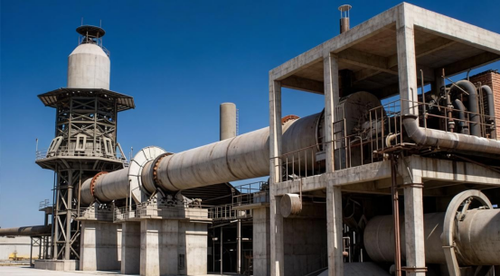
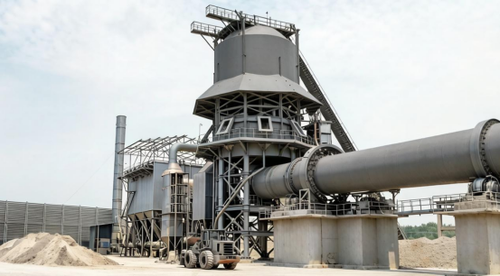
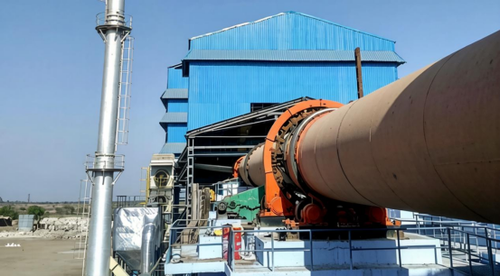
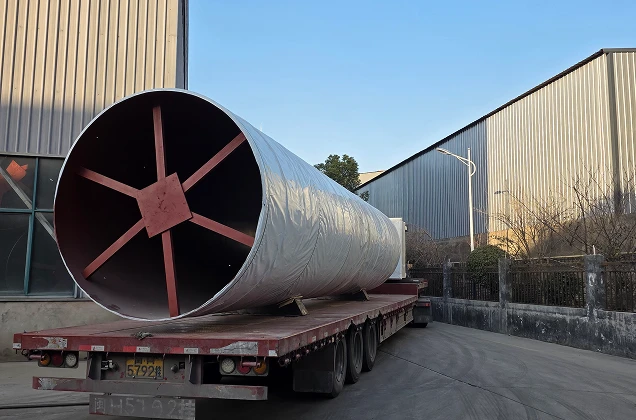
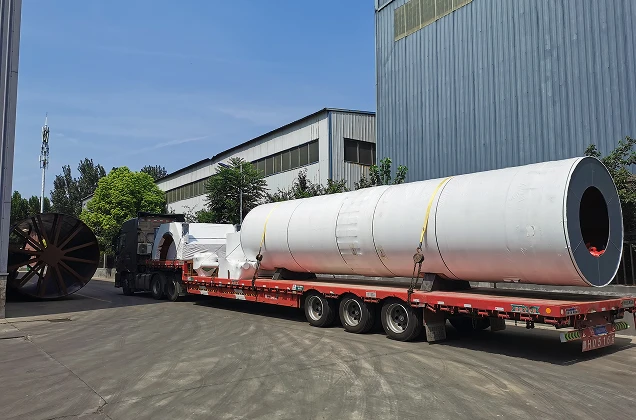
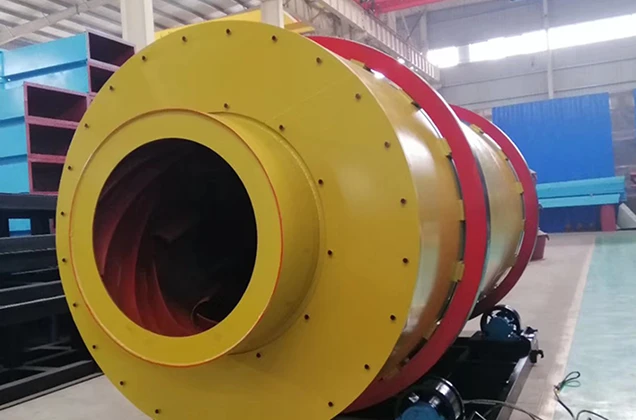
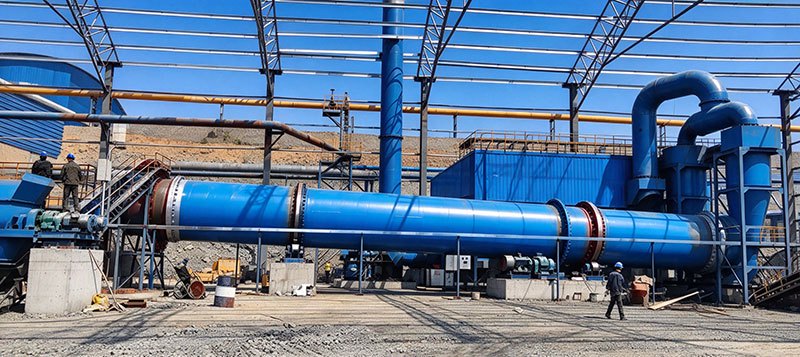
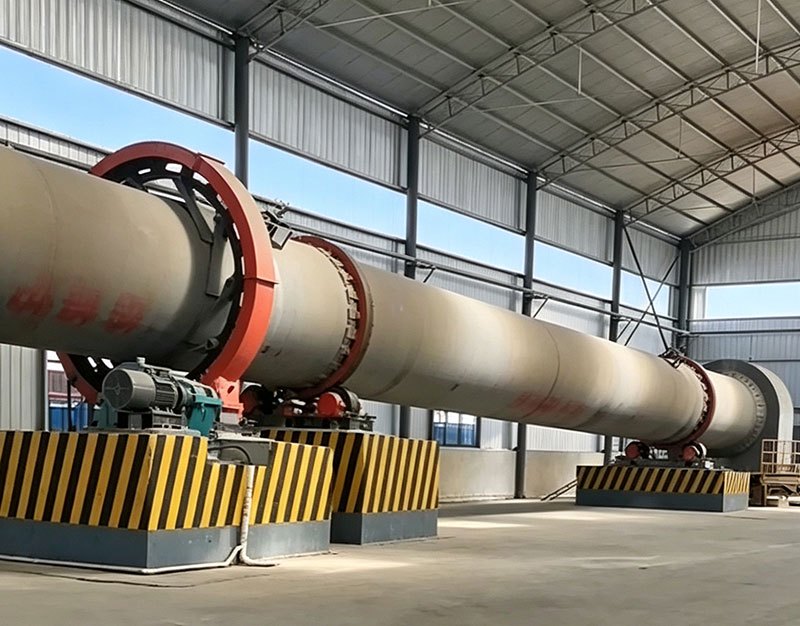
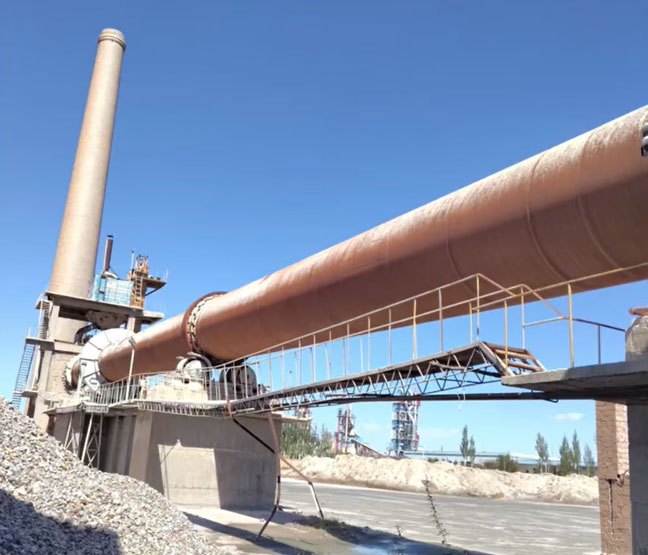
Rotary kiln calcination is a representative device for continuous production. Taking a gypsum rotary kiln as an example, raw gypsum is crushed to 10-25 mm and fed into the kiln. The kiln head temperature is controlled at 450-550°C, the kiln tail temperature at 155-190°C, and the finished product temperature at 150-185°C. The average axial movement speed of the material inside the kiln is about 1 m/min. The internal combustion design of the rotary kiln allows gas to burn directly inside the shell, resulting in high thermal efficiency. In industrial practice, the material temperature inside the kiln during gypsum calcination is mostly 150-160°C, and the material stays in the kiln for more than half an hour, belonging to the "low-temperature slow calcination" method.
Fluidized bed calcination uses fluidization technology, where materials are fluidized under high-pressure air blowing and fully contact the heat exchange medium. Typical parameters for fluidized bed furnaces are: material residence time 15-30 minutes, temperature control 140-160°C, using indirect heat exchange to avoid over-burning, suitable for large-scale continuous production. The thermal efficiency of the fluidized bed body can reach over 95%.
Steam rotary kiln uses indirect heat exchange, and the product hemihydrate gypsum purity can reach 98%. This route is suitable for scenarios with high product purity requirements.
Key Control Points of the Calcination Process
Stability of kiln negative pressure is crucial. Gypsum calcination is usually carried out under slight negative pressure, generally controlled between -5 Pa and -20 Pa. Insufficient negative pressure leads to flue gas leakage and heat loss; excessive negative pressure causes excessive cold air intake, making it difficult to maintain kiln temperature.
Material residence time must match the calcination temperature. Too short a residence time results in incomplete dehydration, more residual dihydrate gypsum in the product, and unstable setting time; too long a residence time increases energy consumption and may cause over-burning. In the rotary kiln process, residence time is usually adjusted through kiln shell speed and inclination, with a typical value of 45-60 minutes.
Control of heating rate is equally critical. Rapid calcination (material temperature exceeding 160°C, residence time only a dozen seconds) leads to crystal defects; slow calcination (residence time exceeding 1 hour) provides stable product quality but increases energy consumption by about 25%. In industry practice, the heating rate of the rotary kiln must be finely adjusted according to raw material characteristics to ensure that the gypsum completes sufficient phase transformation.

III. Cooling and Aging: Overlooked but Critical Post-Treatment
The temperature of calcined gypsum is still above 150°C and cannot directly enter the grinding or packaging stage. Cooling is not only for temperature reduction but also for stabilizing product phase composition. If high-temperature gypsum is directly exposed to air, it will absorb moisture from the air and undergo partial hydration, causing product performance fluctuations.
Cooled gypsum usually needs aging treatment. Aging refers to storing in a silo for a period, allowing residual soluble anhydrite in the gypsum to absorb moisture from the air and convert to hemihydrate gypsum, while eliminating local activity differences caused by uneven calcination. In industry practice, calcined gypsum powder generally needs to be stored in a silo for aging to obtain uniform and stable building gypsum. Aging time is determined according to product type and raw material characteristics, usually from several hours to several days.
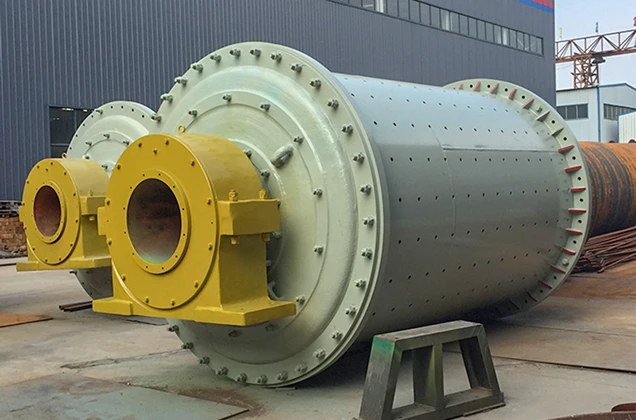
Grinding is another important link. Calcined gypsum needs to be processed by a ball mill or classifier to meet product fineness requirements. Fineness directly affects hydration activity and strength—insufficient fineness leads to insufficient strength, while excessive fineness increases water demand. During grinding, temperature control must be noted to avoid re-dehydration of gypsum caused by friction heat.
IV. Quality Control: From Online Monitoring to Finished Product Testing
Quality control of gypsum calcination is a systematic project throughout the entire process, not just "checking" at the finished product end.
Online Control During the Calcination Process
Temperature monitoring is the most basic control measure. Temperatures at the kiln head, kiln tail, and finished product outlet need real-time monitoring to ensure stable calcination conditions. Rotary kilns are usually equipped with analog panels to achieve automatic control of temperature and pressure by controlling feed rate, oil supply, primary air volume, and secondary combustion air volume.
Monitoring of flue gas moisture content can indirectly reflect the degree of dehydration. Electrostatic precipitators need to be heated to 120°C before startup to prevent water vapor in the flue gas from condensing when cooled, causing hemihydrate gypsum to revert to dihydrate gypsum and affecting the setting time of building gypsum products.
Core Testing Indicators of Finished Products
Phase composition analysis is the core basis for determining calcination quality. The hemihydrate gypsum content is determined by X-ray diffraction (XRD) or chemical analysis. Industry requirements specify hemihydrate gypsum content ≥75%, with premium products reaching over 85%. Excessive residual dihydrate gypsum content leads to unstable setting time and low strength; excessive soluble anhydrite leads to incomplete hydration and insufficient strength.
Setting time is the most direct performance indicator of gypsum products. Determined by standard methods, initial setting time ≥4 minutes, final setting time ≤30 minutes. Abnormal setting time usually points to improper calcination temperature or excessive impurities—prolonged setting time may be due to insufficient calcination or impurity interference, while shortened setting time may be due to over-burning or excessive soluble salt content.
Strength testing includes 2-hour wet compressive strength and dry strength. Building gypsum generally requires 2-hour compressive strength ≥3.5 MPa, dry strength ≥6.0 MPa. Insufficient strength is often related to fineness, purity, or curing conditions.
Fineness testing is carried out by sieving or specific surface area methods. The 45 μm sieve residue is generally required to be ≤12%, and the specific surface area ≥3500 cm²/g.
Common Quality Problems and Traceability
Quality Problem | Possible Causes | Investigation Direction |
|---|---|---|
Prolonged setting time | Insufficient calcination, high residual dihydrate gypsum; impurity interference | Check calcination temperature, raw material purity |
Shortened setting time | Over-burning, excessive soluble anhydrite; excessive soluble salts | Lower calcination temperature, check raw material salt content |
Low strength | Insufficient fineness, low hemihydrate purity, improper curing | Check grinding fineness, phase composition, curing conditions |
Large product performance fluctuations | Insufficient raw material homogenization, unstable calcination regime | Strengthen raw material mixing, stabilize kiln temperature and residence time |
Every link in the gypsum calcination process is interconnected: the moisture and particle size of the raw material determine the setting of calcination temperature, the calcination temperature and time determine the phase composition, and the phase composition determines the setting time and strength. Quality control cannot focus only on finished product testing data; it is necessary to combine online monitoring, process control, and finished product testing to establish a full-chain quality traceability system from raw material to finished product.
Henan Hongke Heavy Industry's mineral processing equipment enjoys significant competitive advantages in the industry. We provide one-stop full-chain services covering pre-sales consultation, in-process follow-up, and after-sales support, ensuring every customer buys with confidence and uses with peace of mind. Click Customer Service Consultation to leave us a message. You are welcome to visit Henan Hongke for on-site inspection and business negotiation. We will provide you with professional solutions and quotations!