

Rotary Kiln Tyre and Support Roller Maintenance & Alignment Guide
Henan Hongke Heavy Machinery Co., Ltd. is a Chinese manufacturer of industrial rotary kilns, rotary dryers, ball mills, crushers and complete production lines. Rotary kilns work under high temperature, heavy load and continuous operation for long periods. Tyres and support rollers are key parts that carry the full weight of the kiln and transfer the load. Their maintenance and alignment quality directly affect kiln operation stability, tyre and roller life and overall line availability. This article reviews the structural role, maintenance points and alignment methods of tyres and support rollers, as a reference for rotary kiln operation and maintenance.
1. Structural Role of Tyres and Support Rollers
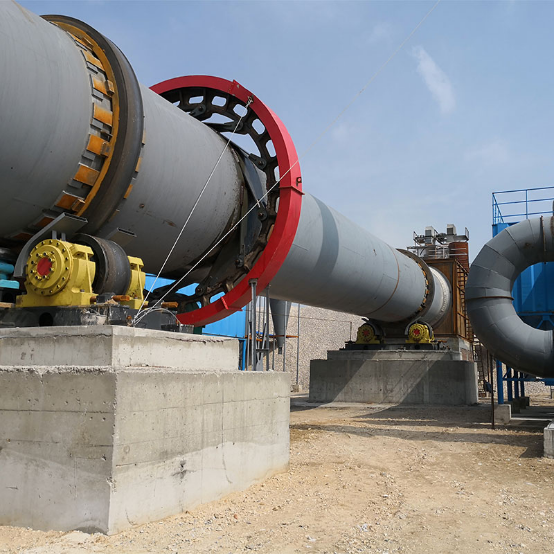
A tyre is a large steel ring fitted around the outside of the rotary kiln shell. It transfers the weight of the shell and refractory to the support rollers. There is usually a gap between the tyre and the shell to allow for thermal expansion. The gap size affects shell ovality and tyre load condition.
Support rollers support the tyres, carry the full weight of the kiln and allow rotation with very low friction. Roller installation accuracy, bearing condition and lubrication directly affect operation stability. Each support station usually has two rollers, and the roller axis must keep the correct relative position with the kiln axis.
Thrust rollers limit axial movement of the kiln. Because the kiln is inclined, the material and kiln weight tend to slide downward, and thrust rollers keep the kiln in position. Tyres, support rollers and thrust rollers together form the kiln support system.
2. Tyre Maintenance Points
Tyre maintenance focuses on clearance, contact condition and crack inspection.
Tyre clearance: the gap between the tyre and the shell should be adjusted according to design requirements and operating temperature. Too small a gap restricts shell thermal expansion and increases shell stress. Too large a gap increases shell ovality and affects the contact condition between tyre and roller. The gap should be measured regularly and the trend recorded.
Tyre and roller contact condition: the contact pattern should be evenly distributed along the tyre width. Contact skew or local contact accelerates tyre and roller wear and requires checking roller position and kiln axis.
Tyre cracks and deformation: tyres carry alternating stress for long periods and should be checked regularly for surface cracks, spalling and deformation. Cracks should be evaluated in time and the tyre replaced if necessary.
Tyre lubrication: the sliding surface between tyre and shell should be properly lubricated to reduce wear and abnormal noise.
3. Support Roller Maintenance Points
Roller maintenance focuses on bearings, lubrication and roller position.
Bearing temperature and vibration: roller bearing temperature and vibration are important indicators of operating condition. Abnormal temperature rise or increased vibration may indicate insufficient lubrication, bearing wear or abnormal roller load.
Lubrication management: roller bearings should be greased on schedule, and grease grade and quantity should follow equipment requirements. Insufficient lubrication accelerates bearing wear, while excessive lubrication may also cause temperature rise.
Roller surface wear: uneven roller surface wear affects contact with the tyre and requires regular checks of roller surface and diameter change.
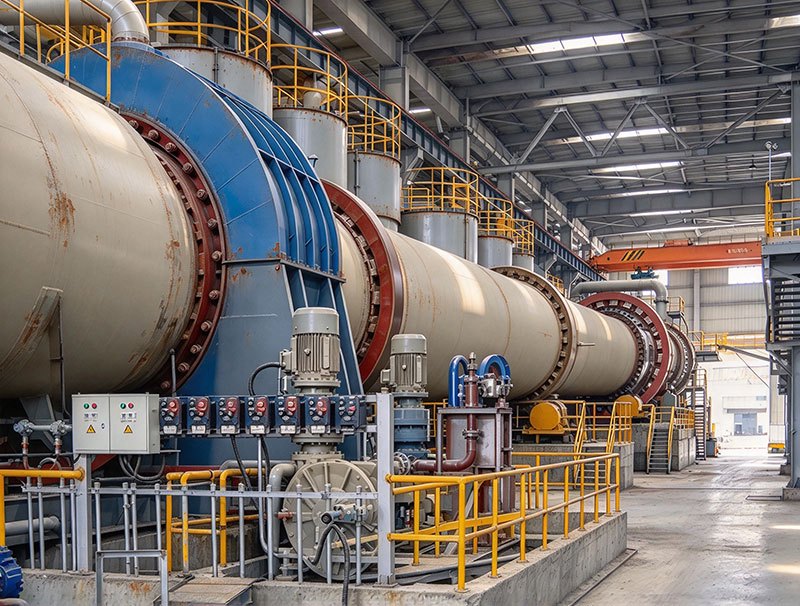
Roller position and axis: roller position deviation changes tyre load and affects kiln axial movement and contact condition. Rollers should be checked and adjusted according to alignment requirements.
Base and anchor bolts: loose roller base and anchor bolts affect roller position stability and should be checked and tightened regularly.
4. Alignment Method and Steps
The purpose of tyre and roller alignment is to keep the kiln axis, tyre and rollers in the correct relative position so that load is transferred evenly. Alignment usually includes the following steps:
Measure the kiln axis: determine the actual kiln axis from shell elevation and horizontal position at the tyre;
Check tyre clearance: measure the gap between tyre and shell at the top, bottom and both sides to judge shell ovality and tyre position;
Check roller contact pattern: judge whether contact is even from the contact marks between tyre and roller;
Measure roller position: check the relative position of roller axis and kiln axis, including horizontal deviation and angle deviation;
Adjust roller base: correct roller position by adjusting shims or base position so that the contact pattern is even;
Check thrust roller condition: confirm the gap between thrust roller and tyre end face meets requirements and limits kiln axial movement;
Observe during operation: after adjustment, observe tyre contact, roller temperature and kiln axial movement, and make fine adjustments if necessary.
Alignment work should be done after the kiln is stopped and cooled. Adjustments should be made step by step, avoiding large one-time changes. Measurement data and adjustment amounts should be recorded after alignment as a reference for later maintenance.
5. Common Problems and Handling
Common Problem | Possible Cause | Handling Suggestion |
|---|---|---|
Tyre and roller contact skew | Roller position deviation, kiln axis offset | Check roller position and kiln axis; adjust according to alignment requirements |
Roller bearing temperature rise | Insufficient lubrication, bearing wear, abnormal load | Check lubrication and bearing condition; investigate roller load |
Abnormal kiln axial movement | Improper thrust roller gap, roller angle deviation | Check thrust roller and roller position; adjust axial limit |
Increased shell ovality at tyre | Excessive tyre clearance, insufficient shell stiffness | Measure clearance; evaluate shell condition |
Tyre surface cracks | Alternating stress, material fatigue | Check regularly; evaluate replacement |
Uneven roller surface wear | Contact skew, foreign material entry | Check contact condition; clean foreign material |
6. Maintenance Cycle and Record Management
Tyre and roller maintenance should be carried out on schedule, and records should be kept. Recommended maintenance content includes:
Daily inspection: check roller temperature, vibration, abnormal noise and lubrication;
Weekly inspection: check tyre clearance, roller surface and thrust roller condition;
Monthly inspection: measure tyre clearance and roller position, and record the trend;
Shutdown maintenance: check tyre cracks, roller bearings and base fastening, and adjust or replace if necessary;
Record management: keep records of tyre clearance, roller temperature, vibration and adjustments to analyze trends and plan maintenance.
7. FAQ
Q1: Why is a gap needed between the tyre and the shell?
The gap allows for thermal expansion of the shell. Too small a gap restricts thermal expansion and increases shell stress. Too large a gap increases shell ovality and affects the contact condition between tyre and roller. The gap should be adjusted according to design requirements and operating temperature.
Q2: At what roller bearing temperature should action be taken?
There is no universal limit for roller bearing temperature. It should be compared with normal operating temperature and alarm settings. If the temperature continues to rise or is clearly higher than other rollers, check lubrication, bearings and load condition.
Q3: How much kiln axial movement is normal?
Kiln axial movement should be within the design allowance. If movement is too large or the kiln frequently hits the thrust rollers, check thrust roller clearance, roller angle and kiln axis.
Q4: Can Henan Hongke provide tyre, roller spare parts and alignment service?
Yes. Henan Hongke can supply tyres, support rollers, thrust rollers, bearings and other spare parts, and provide alignment guidance, installation guidance and maintenance suggestions. For more information, see spare parts and after-sales service.
8. Need Tyre and Support Roller Maintenance Support? Contact Henan Hongke
If you are operating a rotary kiln, or if you need tyre and roller maintenance advice, alignment guidance and spare parts supply, please send the following information to Henan Hongke:
Kiln type, size and running time;
Tyre clearance, roller temperature and vibration records;
Kiln axial movement and thrust roller condition;
Spare part name, specification and quantity to purchase;
Project location and service requirements.
Henan Hongke will provide tyre and roller maintenance advice, alignment guidance and a spare parts supply proposal based on the project conditions. Please use contact Hongke to send your requirements, or visit our products page to learn more about rotary kiln products.